Turkish Citizenship by Investment in 2026: What $400,000 Really Buys
Why we saved citizenship for last
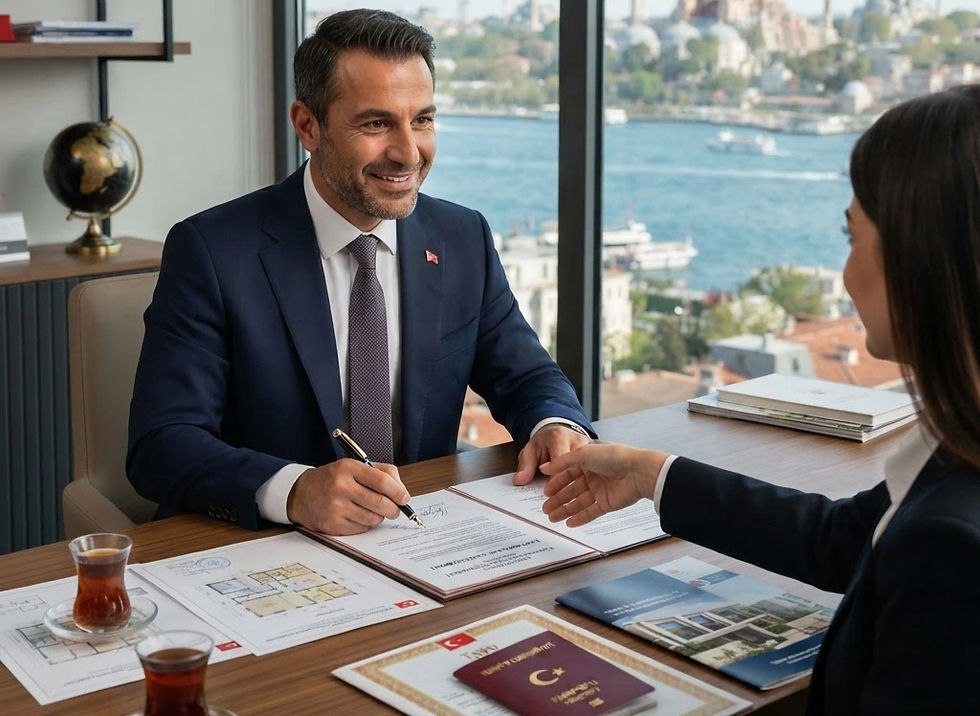
Many international buyers start their Turkey research with citizenship. We deliberately ended with it. On Monday we covered the market and the rules for foreign ownership, and on Wednesday we compared Istanbul with the Antalya coast. Both pieces make the same underlying point: the property has to stand on its own. Citizenship can be a valuable addition to a sound investment, but it cannot rescue a poor one, and the events of 2026 have made that clearer than ever.
What the $400,000 actually buys
Turkey’s programme dates from 2017, when the real estate threshold was USD 1 million. It was cut to USD 250,000 in 2018 and raised to USD 400,000 in June 2022, where it remains today. An investor who buys qualifying property at that level, and agrees not to sell it for three years, can apply for full Turkish citizenship. A spouse and children under 18 are included in the same application.
Three details matter more than the headline number. First, the USD 400,000 refers to the officially appraised value, not the price agreed with the seller. A buyer can pay more than USD 400,000 for a property that appraises below the line and fail to qualify. Second, the qualifying funds must be documented as entering Turkey through the banking system, and the property must be bought from a Turkish citizen or entity rather than another foreigner. Third, the investor can combine several properties to reach the threshold, but each one is appraised and annotated separately.
What the passport itself delivers is solid rather than spectacular. Turkish passport holders can reach roughly 110 to 115 destinations visa-free or with a visa on arrival or e-Visa, which places it mid-table on global indexes. It does not open the Schengen area, where a visa is still required. Its strategic value lies elsewhere: Turkey is a G20 economy and NATO member, there is no requirement to live in the country, dual citizenship is permitted, and Turkish nationals are eligible for the US E-2 treaty investor visa, a route many other passports do not offer.
The other routes on the table
Real estate dominates uptake, but it is not the only path. Each alternative carries a higher minimum and the same three-year commitment.
Qualifying route | Minimum | Condition |
Real estate purchase | USD 400,000 | Officially appraised value; three-year no-sale annotation on the title deed |
Bank deposit in a Turkish bank | USD 500,000 | No withdrawal for three years |
Turkish government bonds | USD 500,000 | Held for three years |
Real estate or venture capital fund shares | USD 500,000 | Held for three years |
How the three-year rule shapes the decision
The holding period is not a formality. Once the purchase is approved for citizenship, the Land Registry places a no-sale annotation on the title deed. Attempting to sell or transfer the property before the three years are up puts the citizenship qualification at risk. For practical purposes, an investor should treat the capital as locked for that period and plan accordingly.
The less obvious consequence comes at the exit. A property that has already been used for a citizenship application cannot qualify a second buyer for citizenship. That removes the citizenship-seeking investor, often the most motivated buyer at the USD 400,000-plus price point, from the resale pool. The practical lesson is to buy something that local buyers and ordinary investors will want in year four, not something priced only for passport seekers. That brings the analysis straight back to Parts 1 and 2: location, building quality, rental demand and liquidity.
A new tax dimension for 2026
This year added a significant consideration for investors who intend to actually relocate. Law No. 7582, published in the Official Gazette on June 4, 2026, introduced a 20-year exemption from Turkish income tax on foreign-source income for individuals who become Turkish tax residents on or after January 1, 2026, provided they were not resident or taxable in Turkey during the previous three calendar years. Exempt foreign income does not have to be declared on a Turkish return, although foreign tax paid on it cannot be credited and related expenses cannot be deducted. Turkish-source income, including Turkish rental income, remains taxable as normal.
Two cautions apply. Citizenship and tax residency are separate things, and the exemption only applies to investors who genuinely move their tax residence to Turkey. Several practical questions are also still being settled in secondary regulations, including exactly how foreign-source income will be defined. This is an area for specialist tax advice in both Turkey and the investor’s home country before any decision is made.
The 2026 enforcement sweep
On August 4, 2026, Turkey’s Interior Ministry announced that the citizenship of 6,134 people who obtained it through the investment programme had been cancelled or withdrawn. The figure covers 1,413 principal investors plus their families, and it falls into two groups. In the larger one, 1,150 investors were found to have completed collusive or irregular transactions, including the use of fraudulent appraisal reports, affecting 5,391 people in total. In the second, 263 investors were flagged by police and the national intelligence service on public order or national security grounds after naturalisation, affecting 743 people. Commentators described it as the largest revocation exercise any major investment migration programme has undertaken.
The same day, Istanbul prosecutors ran the first phase of a criminal investigation into sham property sales linked to a single developer, identifying 687 people who had gained citizenship through low-value properties presented with inflated appraisals. A second phase followed on September 21. Investigators reviewed purchases by 734 foreign nationals across three further developers, classified 274 of those transactions as fraudulent and identified 1,070 people, including family members, who had become citizens through them. The sham sales were valued at more than TL 3.5 billion, around USD 72 million, and courts froze 2,011 properties alongside vehicles, yachts and bank accounts. Proceedings to revoke those citizenships have begun.
The thread runs back further. In September 2025, police dismantled a network that had arranged fictitious sales for 451 investors. Taken together, the message from Ankara is that this is a rolling clean-up of historical files, not a one-off.
What it means for a clean buyer
It is important to read these numbers correctly. The programme has not been suspended, and the threshold has not changed. The enforcement targets manipulated transactions and security cases, not investors who bought properly valued property through genuine sales. Istanbul practitioners quoted in the investment migration press have argued that the clean-up should ultimately leave the programme stronger and more credible internationally.
The structural loophole behind most of the fraud has also been closed. Since March 2024, valuations for citizenship purposes have been carried out by a single state-owned appraisal company, and since December 2024 the certificate confirming a property’s investment value has been generated within the Land Registry’s own system, with paper versions no longer accepted. Valuations are now cross-checked against tax values, sale prices and title deed data. A forged paper appraisal of the kind used in the older schemes no longer has a route into a new citizenship file.
What the sweep does establish is that compliance does not end when the passport is issued. Turkey has shown it is prepared to reopen files years later, and family members’ citizenship falls with the principal investor’s. For a buyer going in now, that translates into a short list of disciplines: confirm the appraised value, not just the price; make sure every dollar is traceable through the banking system; buy from a seller with a clean history; be fully transparent with your own lawyers about anything that could raise a security question; and appoint independent Turkish counsel who represents you alone, rather than relying on the developer or a citizenship agent to arrange the deal.
Where the right partner makes the difference
The investors caught up in this year’s investigations had one thing in common: their transactions were structured around the passport, not the property. TFIB partner TEKCE has spent more than two decades doing the opposite. Founded in Antalya in 2004 and now operating offices across Turkey, Spain, North Cyprus, Sweden and the UAE, the firm combines property selection with in-house legal consultancy and after-sales support. For a citizenship buyer, that means a property chosen to hold its value beyond year three, title and seller checks carried out before contracts are signed, and a documented transaction from first transfer to final title deed.
The series in summary
Over three articles, the picture of Turkey in 2026 is consistent. Fewer foreigners are buying, but they are spending more and choosing more carefully. Istanbul offers depth and income, while the Antalya coast offers lifestyle and seasonal upside. And citizenship remains available at USD 400,000, inside a system that is now actively policing itself. For investors who treat the property as the investment and the passport as the bonus, Turkey remains one of the most interesting frontier-adjacent markets in the world.
Sources
NTL International: Türkiye Citizenship by Investment Enforcement 2026
IFC Review: Fraud resurfaces in Turkey citizenship by investment scheme despite crackdown (Jan 2026)
Legal 500: Turkish Citizenship by Investment, A Complete Guide for 2026
Global Citizen Solutions: Turkey Citizenship by Investment Changes, 2026 Update
Apostille LLC: Turkey Citizenship by Investment, The Appraisal Number Is What Counts
Immigrant Invest: Turkey Citizenship by Investment Program 2026
Attorney Bilal Alyar: Turkish Passport Visa-Free Countries 2026
TFIB publishes market insights for educational purposes. Readers should seek independent legal and tax advice before acquiring property abroad.



Comments