Istanbul vs. the Antalya Coast: Two Markets, Two Investment Theses
Two cities carrying the country
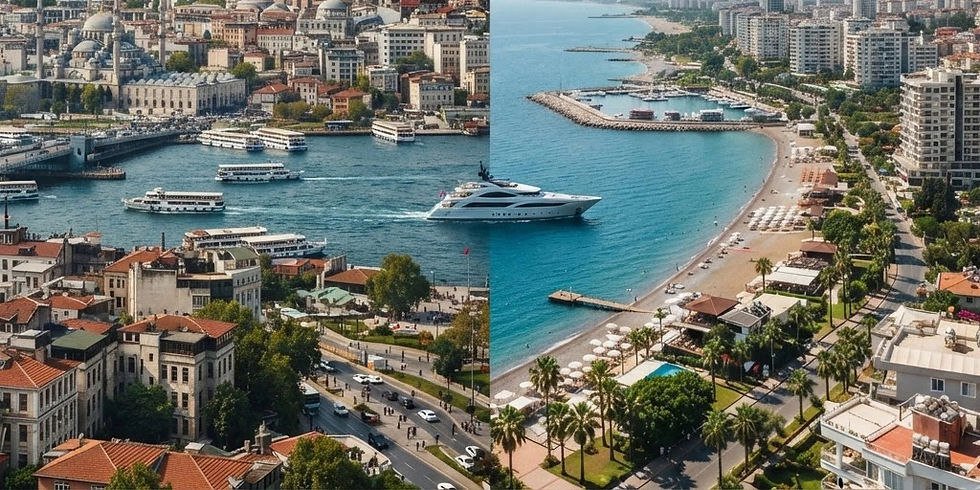
On Monday we looked at Turkey as a whole. In practice, international capital does not buy “Turkey.” It buys Istanbul or it buys the Antalya coast, and the numbers show how concentrated that choice is. In 2025, Istanbul recorded 7,989 home sales to foreigners and Antalya 7,118. Together, that is roughly 70% of the 21,534 homes foreigners bought nationwide.
The more striking detail is the balance between them. Antalya came within a few hundred transactions of Istanbul despite having a fraction of the population. The pattern continued into 2026: in February, Istanbul led with 721 foreign purchases, Antalya followed with 390, and third-placed Mersin trailed far behind at 79. Two markets, then, but built on very different engines.
Istanbul: the liquidity play
Istanbul is Turkey’s economic core, and its property market behaves like one. It is deep, diverse and dispersed. In August 2026, a broad asking-price benchmark across the city’s 39 districts put the average at around TRY 66,905 per square metre, with an average home value near TRY 7.36 million. That average hides an enormous range. Beşiktaş exceeded TRY 184,000 per square metre and Kadıköy TRY 170,000, while the city’s top luxury developments are quoted between USD 10,000 and nearly USD 18,000 per square metre.
For income investors, Istanbul leads the country. Global Property Guide’s H1 2026 data puts the city’s gross residential yield at 8.17%, above the 7.32% national average, supported by year-round tenant demand from professionals, students and a large expatriate community. Just as important, Istanbul offers the deepest resale market in Turkey, which matters for any investor who values an exit.
The growth story is increasingly about transformation. Kağıthane is the textbook case: a district once defined by ageing industrial fabric that has climbed to around USD 2,000 per square metre on the back of new metro links, institutional office development and urban renewal. Investors who identify the next Kağıthane early are the ones Istanbul rewards most.
The risk Istanbul investors cannot ignore is seismic. The city sits close to one of the world’s most closely watched fault lines, and building age and construction standards matter as much as location. Newer stock built to Turkey’s current seismic code, and regeneration projects replacing older buildings, deserve a clear premium in any underwriting.
The Antalya coast: the lifestyle-and-yield play
Antalya is a different proposition entirely. With a population of around 2.5 million and more than 15 million tourists a year, the region’s property market runs on hospitality, retirement and second-home demand. It is also markedly cheaper to enter. The median home in Antalya sits around TRY 4.9 million, roughly USD 114,000, with prices ranging from about TRY 25,000 per square metre in budget districts such as Kepez to TRY 95,000 in premium beachfront Konyaaltı and Lara.
The headline long-term yield is lower than Istanbul’s, at 6.14% gross according to Global Property Guide. The holiday market tells a different story. Antalya’s average nightly rate for short-term rentals is about USD 86, well above Istanbul’s USD 55, and well-managed properties in the tourism zones of Antalya and Alanya can reach gross yields in the high single digits or better. The catch is seasonality. A realistic model has to account for four to five months of sharply reduced or zero holiday income, and net yields after expenses typically settle in the 4–7% range.
Within the province, the sub-markets are distinct. Konyaaltı and Lara are the established premium addresses. Alanya draws strong Scandinavian and German demand at lower prices than central Antalya. Belek is built around golf and resort living, and Kepez offers the lowest entry points for buyers focused on long-term rentals.
The short-term rental reality check
Any investor modelling holiday-let income in either city needs to understand Law No. 7464, in force since January 2024. Renting a home for 100 days or less now counts as a tourism rental and requires a permit from the Ministry of Culture and Tourism, applied for through the e-Devlet portal, with an official plaque displayed at the property entrance. For 2026, the published charges are TRY 5,000 for the permit certificate and TRY 5,000 for the plaque.
The permit itself is not the hard part. In apartment buildings, it requires the consent of the other flat owners, and legal advisers widely describe that as unanimous, which means a single objection can block it. Enforcement is real: fines start at around TRY 100,000 and escalate to more than TRY 1.9 million for systematic violations. And since April 1, 2026, Airbnb has required a valid permit number on every Turkish listing.
The practical lesson is simple. Underwrite long-term rental income as the base case, and treat holiday-let income as upside that is only real if the building is already permitted or the property is a standalone villa. This matters more on the Antalya coast, where the holiday market is the draw, than in Istanbul, where the investment case does not depend on it.
Side by side
Istanbul | Antalya Coast | |
Foreign home purchases, 2025 | 7,989 | 7,118 |
Gross residential yield (H1 2026) | 8.17% | 6.14% |
Price benchmark | City-wide asking average of roughly TRY 66,900/m² (Aug 2026); prime districts above TRY 170,000/m² | Median home around TRY 4.9M (about $114,000); roughly TRY 25,000–95,000/m² by district |
Typical holiday-let nightly rate | About $55 | About $86 |
Rental model | Year-round, long-term demand | Seasonal holiday lets plus long-term expat and retiree demand |
Key risks | Seismic exposure, building age, wide district-by-district dispersion | Seasonality and permit hurdles for short-term letting |
Best suited to | Income, liquidity and growth in regenerating districts | Lifestyle, second homes and professionally managed rentals |
Which market fits which investor
The choice comes down to what the capital is for. An investor seeking steady income, liquidity and a credible exit will find Istanbul’s depth hard to beat, provided they are disciplined about building quality and willing to research district by district. An investor who wants a property they will also use, or who is prepared to run a professionally managed holiday rental with proper permits, will find the Antalya coast offers a lower entry price and a lifestyle Istanbul cannot match.
Many experienced buyers end up holding both: an Istanbul unit for income and a coastal property for use and seasonal upside. The two markets respond to different demand drivers, which makes them complementary rather than competing.
Where the right partner makes the difference
Both markets reward local knowledge, and the Antalya coast in particular rewards knowing which buildings and districts can actually support the rental strategy an investor has in mind. TFIB partner TEKCE was founded in Antalya in 2004 as Antalya Homes, and its five Antalya offices in Lara, Konyaaltı, Döşemealtı, Belek and Alanya map directly onto the sub-markets covered above. In Istanbul, the firm operates as Istanbul Homes. Its in-house legal consultancy and after-sales support are exactly what permit checks, building consent and title verification demand, whichever side of the country an investor chooses.
Coming Friday
We close the series with the question many international buyers start with: citizenship. On Friday, we look at what Turkey’s $400,000 citizenship-by-investment threshold really buys in 2026, how the three-year holding rule shapes the decision, and what this summer’s enforcement sweep means for investors going in.
Sources
TurkStat and Global Property Guide data, via Real Estate All Turkey: Turkish Property Market H1 2026
Homes Overseas: Turkey property sales statistics, February 2026
Orfali Properties: Istanbul Property Price per Square Meter 2026
Virto Property: Turkey Property Prices 2026, Regional Breakdown
Homes of Turkey: Turkey Real Estate ROI, Rental Yield Data by City (2026)
SP Law Istanbul: Airbnb in Turkey, What Foreign Owners Must Know (2026)
RestProperty: Turkey Airbnb and Short-Term Rental Rules 2026
TFIB publishes market insights for educational purposes. Readers should seek independent legal and tax advice before acquiring property abroad.




Comments